VHIO
Stem Cells & Cancer Group
Héctor G. Palmer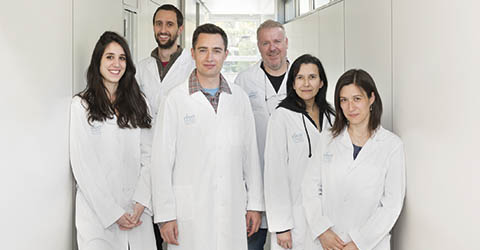
Post-Doctoral Fellows
Isabel Puig, Stephan Tenbaum
Graduate Students
Oriol Arqués
Technician
Irene Chicote
PhD Student
Estefania Cuesta
SUMMARY
Our main interest is to better understand the molecular mechanisms that confer tumors the ability to self-renew, resist therapy, relapse and metastasize – all definitive factors in the survival of patients. In particular, we are dedicated to studying the consequences of intra-tumoral cell heterogeneity for tumor evolution and patient survival. Among the different cell populations that build an heterogeneous tumor, Cancer Stem Cells (CSC) are at the apex of a differentiation process within the cancerous tissue somewhat reminiscent of the hierarchy present in the normal tissue from which they originate. Furthermore, CSC can compose the small reservoir of drug-resistant cells that are responsible for relapse after chemotherapy-induced remission, or give rise to distant metastasis. It is therefore becoming evident that a cancer treatment that fails to eliminate cancer stem cells may allow re-growth of the tumor.
Over recent years we have succeeded in describing a new mechanism of resistance to PI3K and AKT inhibitory drugs conferred by beta-catenin in colorectal cancer. Such discovery is of great clinical relevance since many patients in clinical trials are not responding to these drugs and no molecular explanation behind resistance had previously been described. We are currently leading research focusing on a new generation of Wnt/beta-catenin inhibitory drugs in close collaboration with several major pharmaceutical companies, and have already produced experimental data regarding the efficacy and mechanisms of action of such drugs in pre-clinical models of colorectal cancer with patient-derived xenografts. This marks an important milestone in the field, since colorectal cancer was described as a paradigmatic tumor addicted to the oncogenic Wnt/beta-catenin pathway many decades ago. We are also identifying the molecular determinants of response to these drugs that could become robust biomarkers to select sensitive patients and guide the design of new clinical trials in the future. Some of these predictive biomarkers are mutations affecting components of the Wnt/beta-catenin pathway, whose identification can be perfectly standardized in clinical practice for patient selection.
PUBLICATIONS
Our research endeavors and efforts for 2014 will most certainly translate in key publications in 2015-2016. For the purposes of this year's Scientific Report we have decided not to advance our results from 2014. We will report on our findings in the 2015 edition once they have been published in specially targeted scientific titles of excellence.MAIN RESEARCH PROJECTS
View- New drugs to target the oncogenic Wnt/beta-catenin pathway (CIBOT).
Novartis International AG
2013-2015
Principal Investigator: Héctor G. Palmer - Wnt/beta-catenin inhibitors to treat colorectal cancer.
Merck Serono GmbH
2013-2014
Principal Investigator: Héctor G. Palmer - Study of metastasis and resistance to PI3K/Akt and Wnt/beta-catenin inhibitors in colon cancer. Analysis of intra-tumoral cell heterogeneity.
Instituto de Salud Carlos III. Proyecto FIS – PI11/02499.
2012-2015
Principal Investigator: Héctor G. Palmer