Oncology
Animal Models and Cancer Laboratory, Melanoma Project
Juan Angel Recio Conde, Vicenç Garcia Patos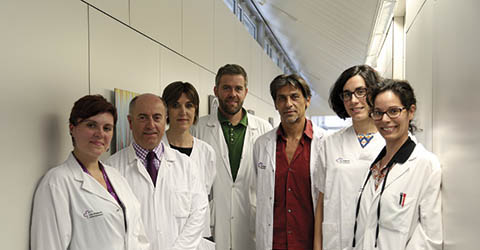
Researchers
Mileidys Pérez Alea, Eva Muñoz Cosuelo
Researchers in training
Elena González Sánchez, Antonio de las Heras, Berta Ferrer Fabregas
Technician
Sara Sánchez-Redondo
SUMMARY
In a study, published in Plos Genetics, we used a UV-induced skin cancer mouse model (Hepatocyte growth factor (HGF) transgenic mice), where one of the two Lkb1 gene alleles was deleted (haploinsufficiency), and consequently the amounts of LKB1 protein was half of the normal levels. A single dose of UVB radiation in Lkb1 haploinsufficient neonates mice expressing HGF was enough to induced the quickly development of squamous cell carcinomas, and this, was associated to a deficient response in DNA damage repair. Moreover, cells harboring the damaged DNA were resistant to cell death (apoptosis). Thus, lack of LKB1 promotes a double effect: cells not only fail to repair the damage in their DNA, but they do not die, leading to the accumulation of mutated cells and the development of tumors. We have obtained similar results (to be published soon) in two additional mouse models of melanoma, a much more lethal type of UV-induced skin cancer.
This model reflects the real scenario for cancer adquisition where initially just one of gene copies is damaged. It also reproduces a tumor related to chronic DNA damage using a single dose of UV radiation providing important insights into how cells can defend themselves from external genotoxic damage
Importantly, these results can be extrapolated to human cancer. In fact, when examining the expression of LKB1 protein in samples from patients with skin tumors, we found that roughly half of these samples showed low or no expression of LKB1. Furthermore, absence of the protein was detected in all stages of the disease, particularly in UV-exposed skin areas, suggesting that the loss of expression of LKB1 is an early event and very likely contributes to UV-induced skin cancer development.
Additionally, we are very interested in finding novel therapeutic alternatives for melanoma treatment. In this matter we are exploiting cancer metabolism as a way to find new alternatives to treat this disease. Metabolic settings of aggressive tumor cells adapt to their energetic and anabolic demands. While limited success in cancer treatment using targeted therapy has been accomplished, the altered metabolism of tumor cells compared to normal cells, provides a viable novel target for a non-toxic chemotherapeutic approach. In melanoma ~50% of tumors present activating mutations in BRAF (BRAFV600E) and another 20% present activating mutations in NRAS (NRASQ61L). While targeted therapy of BRAFV600E mutant tumors has been partially successful there is no therapeutic alternative for patients harboring NRASQ61L mutant tumors. Despite the fact that these molecules affect the same pathway (RAS-ERK1/2), BRAFV600E and NRASQ61L mutant cells behave and respond differently to therapy and to metabolic stress. Understanding the metabolic settings of BRAFV600E and NRASQ61L mutant melanoma tumors would help to sensitize them, overcome resistance mechanisms to therapy and target them according to their genetic alterations. We have defined the different metabolic settings of melanomas harboring different oncogenic mutations and partially identified the biochemical mechanisms responsible for the differential metabolic stress response according to their genotype. We are also conducting a preclinical study in collaboration with the Industry to test the therapeutic capabilities of ALDH isoform-specific inhibitors in melanoma, lung and breast tumors.
PUBLICATIONS
- A mouse model uncovers LKB1 as an UVB-induced DNA damage sensor mediating CDKN1A (p21WAF1/CIP1) degradation. Esteve-Puig R, Gil R, González-Sánchez E, Bech-Serra JJ, Grueso J, Hernández-Losa J, Moliné T, Canals F, Ferrer B, Cortés J, Bastian B, Ramón Y Cajal S, Martín-Caballero J, Flores JM, Vivancos A, García-Patos V, Recio JA. PLoS Genet. 2014 Oct 16;10(10):e1004721. doi: 10.1371/journal.pgen.1004721. eCollection.
- New approach to cancer therapy based on a molecularly defined cancer classification. Cortés J, Calvo E, Vivancos A, Perez-Garcia J, Recio JA, Seoane J. CA Cancer J Clin. 2014 Jan -Feb;64(1):70-4. doi: 10.3322/caac.21211. Epub 2013 Nov 18. Review.
MAIN RESEARCH PROJECTS
View- Unraveling metabolic settings and targeting metabolic enzymes with selective lethality in BRAF and NRAS mutant melanoma tumors
Funding Entity: European Union, Marie Curie Actions.
Scientific coordinator: Juan Angel Recio Conde
City: Brusells, Belgium - Estudio de la función de LKB1 y de los mutantes asociados a melanoma
dirigido a la creación de terapías personalizadas efectivas.
Principal Investigator: Juan Angel Recio Conde
Funding Entity: Instituto de Salud Carlos III - Preclinical study in melanoma and lung cancer using specific inhibitors of ALDH
Principal Investigator: Juan Angel Recio Conde
Funding Entity: Advance Biodesign
City: Lyon, France.