VHIO
Translational Genomics Group
Aleix Prat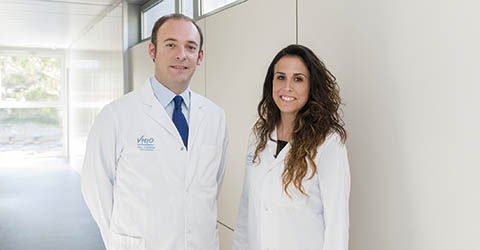
Clinical Research Technician
Patricia Galván
Specialist Physician in Breast Cancer (collaboration)
Maria Jesus Vidal Losada
SUMMARY
2014 has been a highly productive year for VHIO’s Translational Genomics Group. We have been the first in Europe to successfully implement a clinically applicable gene expression-based test, known as PAM50, for the management of breast cancer patients. In addition, we have analyzed >500 samples and provided scientific guidance and advice to several collaborators both at VHIO and overseas, leading to multiple publications in high-impact factor journals. Moreover, my lab has started participating in the genomic analyses of tumor samples from several national and international clinical trials (e.g. PAMELA, NOAH, NeoEribulin, EGF30008, TBCRC018, EGF104900, LPT109096, CIBOMA/2004-01/ GEICAM 2003-11 and CHER-LOB).
We have led important advances regarding HER2- positive breast cancer, in part, thanks to a Susan G. Komen Career Catalyst Research Grant. In a first article, published in the Journal of the National Cancer Institute (JNCI), we showed that HER2-positive disease can be classified as four different subtypes according to respective molecular characteristics, and these different groups might predict a different response to therapies and survival outcome. In a second article, published in Clinical Cancer Research, we reported that among the different subtypes of HER2+ disease, the HER2-enriched is the one to benefit the most from anti-HER2 therapies. These findings have led to the initiation of a prospective clinical trial in HER2+ breast cancer that will test a particular hypothesis using genomic data.
PUBLICATIONS
- Prat A, Bianchini G, Thomas M, Belousov A, Cheang M, Koehler A, Gómez P, Semiglazov V, Eiermann W, Tjulandin S, Byakhow M, Bermejo B, Zambetti M, Vazquez F, Gianni L, Baselga J. Research-based PAM50 subtype predictor identifies higher responses and improved survival outcomes in HER2-positive breast cancer in the NOAH study. Clinical Cancer Research 2014 Jan 15; 20(2):511-21.
- Anderson WF, Rosenberg PS, Prat A, Perou CM and Sherman ME. How many etiological subtypes of breast cancer: two, three, four, or more? J Natl Cancer Inst. 2014 Aug 12;106(8).
- Phillips S, Prat A, Sedic M, Proia T, Wronski A, Mazumdar S, Skibinski A,Shirley SH, Perou CM, Gill G, Gupta PB, Kuperwasser C. Cell-State Transitions Regulated by SLUG Are Critical for Tissue Regeneration and Tumor Initiation.Stem Cell Reports. 2014 Apr 24; 2(5):633-47.
- Prat A, Carey LA, Adamo B, Vidal M, Tabernero J, Cortés J, Parker JS, Perou CM and Baselga J. Molecular Features and Survival Outcomes of the Intrinsic Subtypes within HER2-Positive Breast Cancer. J Natl Cancer Inst. 2014 Aug 19:106(8).
- Prat A, Cruz C, Hoadley KA, Díez O, Perou CM, Balmaña J. Molecular features of the basal-like breast cancer subtype based on BRCA1 mutation status. Breast Cancer Res Treat. 2014 Aug; 147(1):185-91.
Jenkins EO, Deal AM, Anders CK, Prat A, Perou CM, Carey LA, Muss HB. Age-Specific Changes in Intrinsic Breast Cancer Subtypes: A Focus on Older Women. Oncologist. 2014 19(10):1076-83.
MAIN RESEARCH PROJECTS
View- Implementation of the nCounter Nanostring platform.
- Creation of VHIO’s first breast cancer gene expression-based dataset.
- Participate in the NEOERIBULIN clinical trial.
- Compare gene expression-based predictors in breast cancer.
- Genomic characterization of breast cancer.