VHIO
Cancer Genomics Group
Ana Vivancos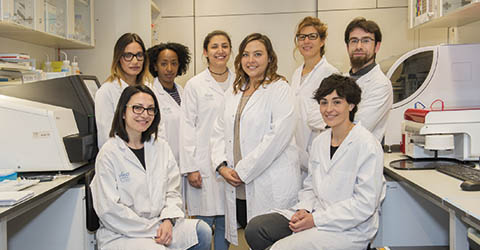
Specialized Technicians
Ginevra Caratú, Deborah G. Lo Giacco, Judit Matito, Leire Mendizábal, Zighereda Ogbah
Bioinformatician
Daniel Silbershchmidt
SUMMARY
VHIO’s Cancer Genomics Group serves as a Core Technology Lab. Our activities bridge the preclinical and clinical fields of cancer research. We work on providing cutting-edge applications in cancer genomics through the use of new technologies and protocol development. In 2014 we validated and incorporated an Amplicon-seq VHIOCard panel (NGS) to facilitate mutation detection in 61 genes and, therefore, improve our routine patient prescreening. Analysis of frequent point mutations (hotspots) in oncogenes is achievable through the use of various techniques including sequencing, qPCR, BEAMing or singlebase extension chemistries. The analysis and relevance of mutations in tumor suppressor genes (e.g. TP53, PTEN, VHL, NF1 etc.), is however hampered by the fact that they occur broadly along the coding sequence. The wide mutation distribution in tumor suppressor genes is due to the fact that tumor cells need only inactivate their products.
Assessment of the mutational status of tumor suppressor genes can only be accomplished by Sequencing-based approaches such as NextGen sequencing. We developed and validated a panel of over 800 amplicons in 61 genes that allows for the interrogation of mutations in oncogenes as well as tumor suppressor genes , and shows a five-fold increase in mutation detection compared to our genotyping platform in a cost effective manner. We also validated and implemented a Gene Fusion panel based on nCounter technology in order to prescreen patient samples.
PUBLICATIONS
- A mouse model uncovers LKB1 as an UVB-induced DNA damage sensor mediating CDKN1A (p21WAF1/CIP1) degradation. Esteve-Puig R, Gil R, González-Sánchez E, Bech-Serra JJ, Grueso J, Hernández-Losa J, Moliné T, Canals F, Ferrer B, Cortés J, Bastian B, Ramón Y Cajal S, Martín-Caballero J, Flores JM, Vivancos A, García-Patos V, Recio JÁ.PLoS Genet. 2014 Oct 16;10(10).
- Genomic analyses across six cancer types identify basal-like breast cancer as a unique molecular entity.Prat A, Adamo B, Fan C, Peg V, Vidal M, Galván P, Vivancos A, Nuciforo P, Palmer HG, Dawood S, Rodón J, Ramony Cajal S, Del Campo JM, Felip E, Tabernero J, Cortés J. Sci Rep. 2013 Dec 18;3:3544.
- New approach to cancer therapy based on a molecularly defined cancer classification. Cortés J, Calvo E, Vivancos A, Perez-Garcia J, Recio JA, Seoane J. CA Cancer J Clin. 2014 Jan-Feb;64(1):70-4. doi: 10.3322/caac.21211. Epub 2013 Nov 18. Review.