Epidemiology, Pharmacology, New Therapies, Clinical Research
Cell and Gene Therapy
Jordi Barquinero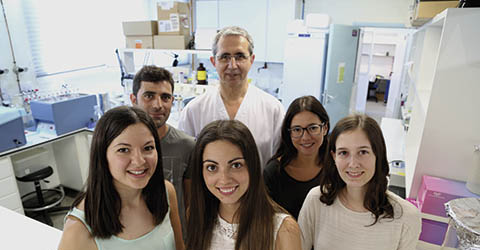
Researchers
Lluís Martorell Cedrés
Researchers in trainings
Silvia Casacuberta-Serra, Arantxa Golbano, Marta Parés Casellas, Elena Perpiñán Mas
SUMMARY
In a collaboration with the group of Drs. C. Espejo and X. Montalban we have found that myeloid-derived suppressor cells (MDSCs) are ideal vehicles to present autoantigens in a tolerogenic manner in the murine model of multiple sclerosis.
In the context of an European consortiun that we coordinate, using iPSCs from hemophilia patients that were differentiated to “hepatocyte-like” cells, we have generated, for the first time, a cellular model of the disease that allows molecular characterization at the RNA level.
Finally, in collaboration with the group of Dr. R. Martí, we used an adenoassociated vector (AAV2/8) encoding thymidine phosphorylase (TP) transcriptionally targeted to the liver to correct the biochemical abnormalities in a murine model of mitochondrial neurogastrointestinal encephalomyopathy (MNGIE). Also in 2014 we got orphan drug designation (ODD) for this vector, which we are now planning to use in a phase I/II clinical trial in patients with this rare and devastating disease. Also in this line of research we demonstrated that the TP gene is not only the therapeutic gene for this disease, but it can also behave as a suicide gene in the presence of the 5-fluorouracil drug capecitabine.
PUBLICATIONS
- Gomez A, Espejo C, Eixarch H, Casacuberta-Serra S, Mansilla MJ, Sánchez R, Pereira S, López-Estévez S, Gimeno R, Montalbán X, Barquinero J. Myeloid-derived suppressor cells are generated during retroviral transduction of murine bone marrow. Cell Transplant 2014; 23: 73-85.
- Torres-Torronteras J, Viscomi C, Cabrera R, Cámara Y, Di Meo I, Barquinero J, Hirano M, Zeviani M, Martí R. Gene therapy using a liver-targeted AAV vector restores nucleoside and nucleotide homeostasis in a murine model of MNGIE. Mol Ther 2014; 22: 901-7.
- López-Estévez S, Ferrer G, Torres-Torronteras J, Mansilla MJ, Casacuberta-Serra S, Martorell L, Hirano M, Martí R, Barquinero J. Thymidine phosphorylase is both a therapeutic and a suicide gene in a murine model of mitochondrial neurogastrointestinal encephalomyopathy (MNGIE). Gene Ther 2014; 21: 673-81.
- Casacuberta-Serra S, Martorell L, Barquinero J.Hematopoietic chimerisms: friends or foes?. Adv Reg Biol 2014; 1: 24429.
MAIN RESEARCH PROJECTS
View- PS09/00237. Desarrollo de nuevas estrategias basadas en terapia génica para inducir tolerancia en un modelo experimental de esclerosis múltiple. Papel de las células mieloides supresoras. FIS (ISCIII). Duración: 2010-2013. IP: J. Barquinero.
- PLE2009.0100. Generation and differentiation of disease-free induced pluripotent stem cells (iPSCs) in genetic diseases of the lymphohematopoietic system. Plan E, Ministry of Science & Innovation. Duración: 2010-2013. IP (Vall d’Hebron node): J. Sánchez de Toledo, Coordinador: J. Bueren (CIEMAT, Madrid).
- HEMO-iPS. Use of patient-specific induced pluripotent stem cells to improve diagnosis and treatment of hemophilia A. European Union (e-Rare-2 JTC 2011). Duración: 2012-2016. IP y coordinador: J. Barquinero.
- PI12/01001. Generación y caracterización de células mieloides supresoras a partir de monocitos humanos y progenitores hematopoyéticos. FIS (ISCIII), Duración: 2013-2015. IP: J. Barquinero.
- Study of the efficacy of drugs with ability to restore dystrophin expression in myoblasts from patients with DMD with nonsense mutations, analysis of the causes that determine the variability in the response and evaluation of strategies to increase the effectiveness in human myoblasts and in the mdx mouse. Duchenne Parent Project Association (Spain). Duración: 2014-2016. IP: F. Munell.